
Healthcare industry involves the use of our expertise to record, assess, and distribute patient-related data. Our goal in the healthcare industry is to improve the overall health of the population by improving the quality of care that patients receive. We assist in the delivery of more accurate, actionable, and more accessible information related to patients’ health, and this information is better customized to meet the needs of individuals and brace shared decision making between healthcare professionals and patients.
We inaugurate networks of social support for patients and healthcare professionals alike.
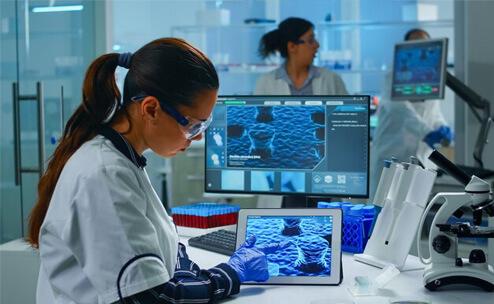
The unique power of AI is that it not only contingent human skills but significantly lengthen the scope of human activity. Some of the AI-related technologies include among others, natural language processing, intelligent agents, computer vision, machine learning, expert systems, chatbots and voice recognition.
Augmented reality differs from VR in two respects: users do not lose touch with reality and it puts information into eyesight as fast as possible. These distinctive features enable AR to become a driving force in the future of medicine; both on the healthcare providers’ and the receivers’ side.
As the future of medicine and healthcare is closely connected to the empowerment of patients as well as individuals taking care of their own health through technologies, I cannot leave out health trackers, wearables and sensors from my selection. They are great devices to get to know more about ourselves and retake control over our own lives.
Virtual reality (VR) is changing the lives of patients and physicians alike. In the future, you might watch operations as if you wielded the scalpel or you could travel to Iceland or home while you are lying on a hospital bed.
One of the most exciting and fastest growing fields of healthcare is robotics; developments range from robot companions through surgical robots until pharmabotics, disinfectant robots or exoskeletons.
iMorse helps healthcare organizations plan and build practical digital products that support customers, employees, and day-to-day operations. Our teams combine product strategy, user experience, web and mobile development, integrations, and ongoing support so the technology remains useful as the business grows.
Healthcare organizations can improve access to information through secure patient workflows, scheduling, records, communication, and reporting tools. We prioritize usability, privacy, role-based access, and reliable integrations so digital systems support better service without adding unnecessary complexity for staff. We begin with the business objective, review existing workflows, and recommend a scalable implementation with clear milestones, measurable outcomes, and room for future improvements. This approach helps organizations reduce manual work, improve service quality, and make better decisions from reliable information.
What can be digitized first? Most projects begin with a high-impact workflow such as customer communication, scheduling, reporting, ordering, records, or internal approvals. We identify the best starting point during discovery.
Can the solution integrate with existing systems?Yes. We assess your current tools and design APIs, dashboards, and workflows that fit your technology environment instead of forcing an unnecessary replacement.